Standing seam metal roofing, fabricated to fit your home.
Raised, interlocking seams and hidden fasteners — the cleanest, longest-lasting metal roof there is. Roll-formed in our own shop, snap-lock or mechanically seamed, and installed to Florida’s high-wind code by a local licensed crew.
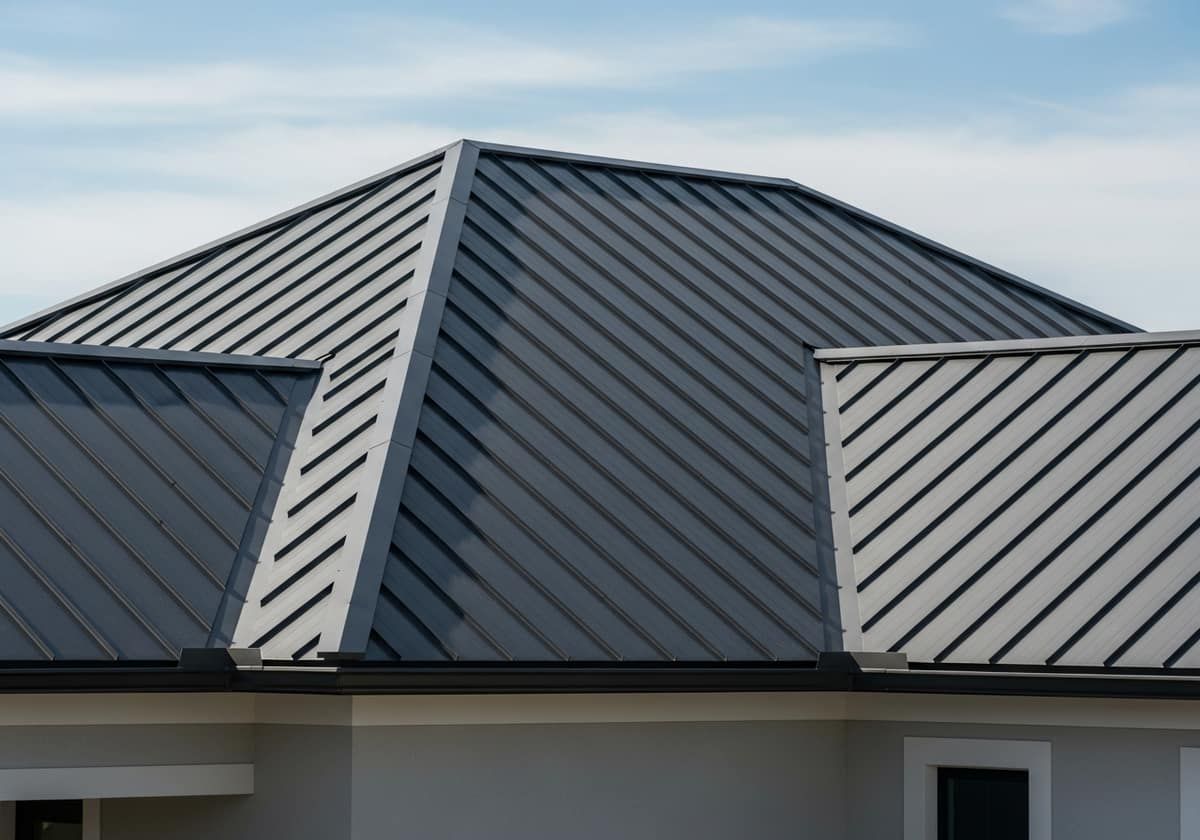
What makes a roof “standing seam”
A standing seam metal roof is built from long, vertical panels whose edges are folded up into raised, interlocking seams that run unbroken from the ridge to the eave. Those seams stand proud of the flat of the panel — that is where the name comes from — and they do the most important job on the roof: they conceal the fasteners. The panels are held down by hidden clips anchored to the deck, so there are no screws or rubber washers driven through the face of the metal where the sun, rain, and salt can get at them.
That single trait is the whole reason standing seam sits at the top of metal roofing. The other kind of metal roof — exposed-fastener panels, the ribbed or 5V sheets screwed straight through the surface — is cheaper to install, but every one of those hundreds of gaskets is a future leak as the washers harden and the screws back out in Florida’s heat. A concealed-fastener standing seam roof has nothing exposed to fail, lets the panels move as they expand and contract, and holds a clean, modern line that an HOA or a review board is glad to see.
Engineered for salt, sun & wind uplift — fabricated to fit
Palm Beach County roofs take Atlantic salt air, relentless UV, and some of the state's highest wind-uplift loads. Standing seam answers all three — and because we roll-form the panels and bend the flashing ourselves, we build to the exact lengths and details your roof needs.
Snap-lock vs. mechanically-seamed
Every standing seam roof closes its seams one of two ways, and the right choice comes down to your roof’s slope and how exposed it is — not to whatever a salesperson stocks.
- Snap-lock — the edge of one panel snaps over the next by hand, no seaming tool required. It installs faster and, on most steeper-pitched roofs, performs beautifully. For a sheltered inland home it often delivers the exact standing seam look for less.
- Mechanically-seamed — a powered seamer folds the seam shut, either a single 90° lock or a double-lock for the most demanding jobs. It gives the highest wind-uplift and water resistance and is the right system on low slopes and on barrier-island and oceanfront roofs that take the full force of a storm.
For a beachfront or island roof we usually recommend a mechanically double-locked seam; for a protected inland roof, snap-lock is frequently the smarter spend. We match the seam to your home, then fabricate the panels to suit it.
| Snap-Lock | Mechanically Seamed | |
|---|---|---|
| How the seam closes | Snaps together by hand | Folded shut with a powered seamer |
| Best slope | Steeper, well-pitched roofs | Low slopes & steep alike |
| Wind-uplift resistance | High | Highest (double-lock) |
| Best fit here | Sheltered inland homes | Barrier-island & oceanfront |
| Relative cost | Lower install labor | Higher — more hand-work |
Why standing seam earns its place on a Palm Beach roof
Want a real number for your roof? We measure on-site and quote in writing.
Get a Free EstimateThe metal, the profile, and the finish are yours to choose
“Standing seam” is a family of profiles, not one panel. Seam heights and panel widths change the proportion and the shadow line; a striated or pencil-rib pane keeps a wide panel from oil-canning in the flat. We help you choose the profile that suits the architecture — a tight, narrow pan for a clean modern home, a broader pan for a ranch — then roll-form it in our shop to match.
The metal itself is a real decision, too:
- Aluminum — the workhorse on the coast: it simply does not rust, which is why it is a natural first choice within sight of the salt water.
- Galvalume steel — strong and economical, with a durable factory paint finish (Kynar / PVDF) in a wide range of colors that hold up to the UV.
- Zinc — a soft, self-healing metal that weathers to a refined matte gray and lasts for generations.
- Copper — the estate standard: soldered seams, a living patina, and the in-kind material the island’s review boards expect. See our copper roofing page.
Factory finishes come in standard architectural colors plus low-gloss and weathered tones; we’ll get you real samples to see in your own light before anything is ordered.
What standing seam metal roofing costs here
Standing seam costs more up front than asphalt shingle and lands near or above tile — it is engineered metal installed by trained hands. Two homes of the same square footage can still quote far apart, because the price is the sum of a handful of choices:
- Roof size, pitch & complexity — valleys, hips, dormers, and penetrations all add hand-fabricated flashing and labor.
- Metal & gauge — aluminum and Galvalume sit below zinc and copper; a heavier gauge costs more but stands up better on the coast.
- Seam type — a mechanically double-locked seam takes more time on the roof than snap-lock.
- Tear-off & deck — removing the old roof and repairing any rotten decking or replacing underlayment.
So we give you a real figure after an on-site measure rather than a phone guess. Weighed over a 50-year service life — and the wind-mitigation insurance credit a new metal roof can earn — the cost per year often beats a roof you have to replace twice. When you’re ready, book a free estimate or compare the wider category on our metal roofing page.
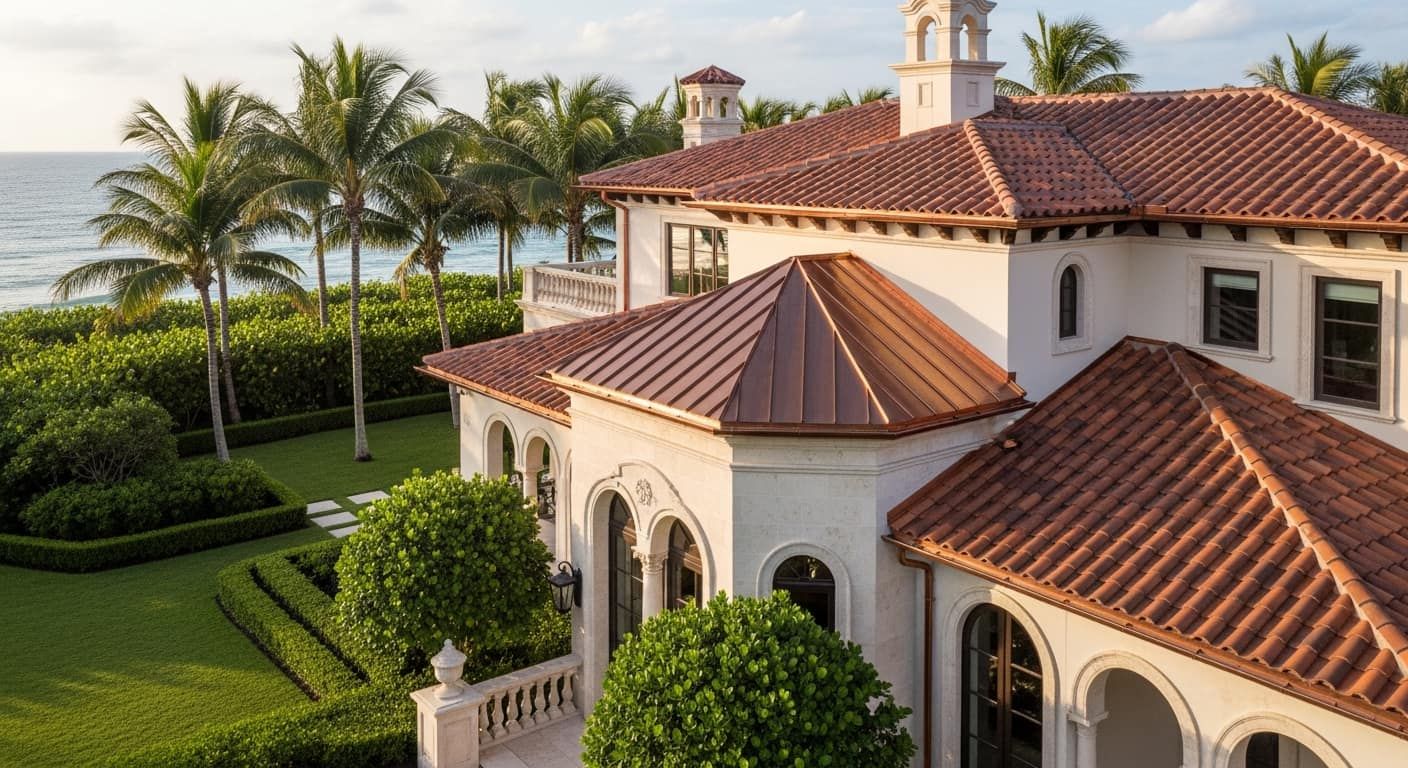
On the island, a copper standing seam roof the review boards approve.
On the Town of Palm Beach, ARCOM and Landmarks expect in-kind clay tile, slate, or copper — and deny asphalt on the historic estates. A soldered copper standing seam roof, with matching copper flashing and gutters, is exactly the kind of period-correct work that earns approval. We build to that standard and carry the architectural review.
Standing seam metal roofing FAQs
What is standing seam metal roofing?
Snap-lock vs. mechanically-seamed — which is better in Palm Beach County?
How much does standing seam metal roofing cost in Palm Beach County?
How long does a standing seam metal roof last?
Is standing seam metal roofing good for hurricanes and high wind?
Can I get a copper standing seam roof on the Town of Palm Beach?
Standing seam metal roofing across Palm Beach County
- Palm Beach Standing seam metal roofing
- West Palm Beach Standing seam metal roofing
- Boca Raton Standing seam metal roofing
- Delray Beach Standing seam metal roofing
- Jupiter Standing seam metal roofing
- Palm Beach Gardens Standing seam metal roofing
- Wellington Standing seam metal roofing
- Boynton Beach Standing seam metal roofing
- Lake Worth Beach Standing seam metal roofing
- Royal Palm Beach Standing seam metal roofing
- Singer Island Standing seam metal roofing
See what a standing seam roof would look like on your home.
A local estimator measures the roof, talks you through seam type, metal, gauge, and color, and leaves you with a clear written quote. We fabricate the panels and flashing ourselves — no pressure, no call center.