Palm Beach island roofing, to ARCOM & Landmarks standard
On the Town of Palm Beach, your roof is a reviewed architectural element. ARCOM (Town Code Ch. 18, Art. III) and the Landmarks Commission require in-kind clay tile, slate, or copper — and routinely deny asphalt on historic estates. We build to that standard and shepherd the review.
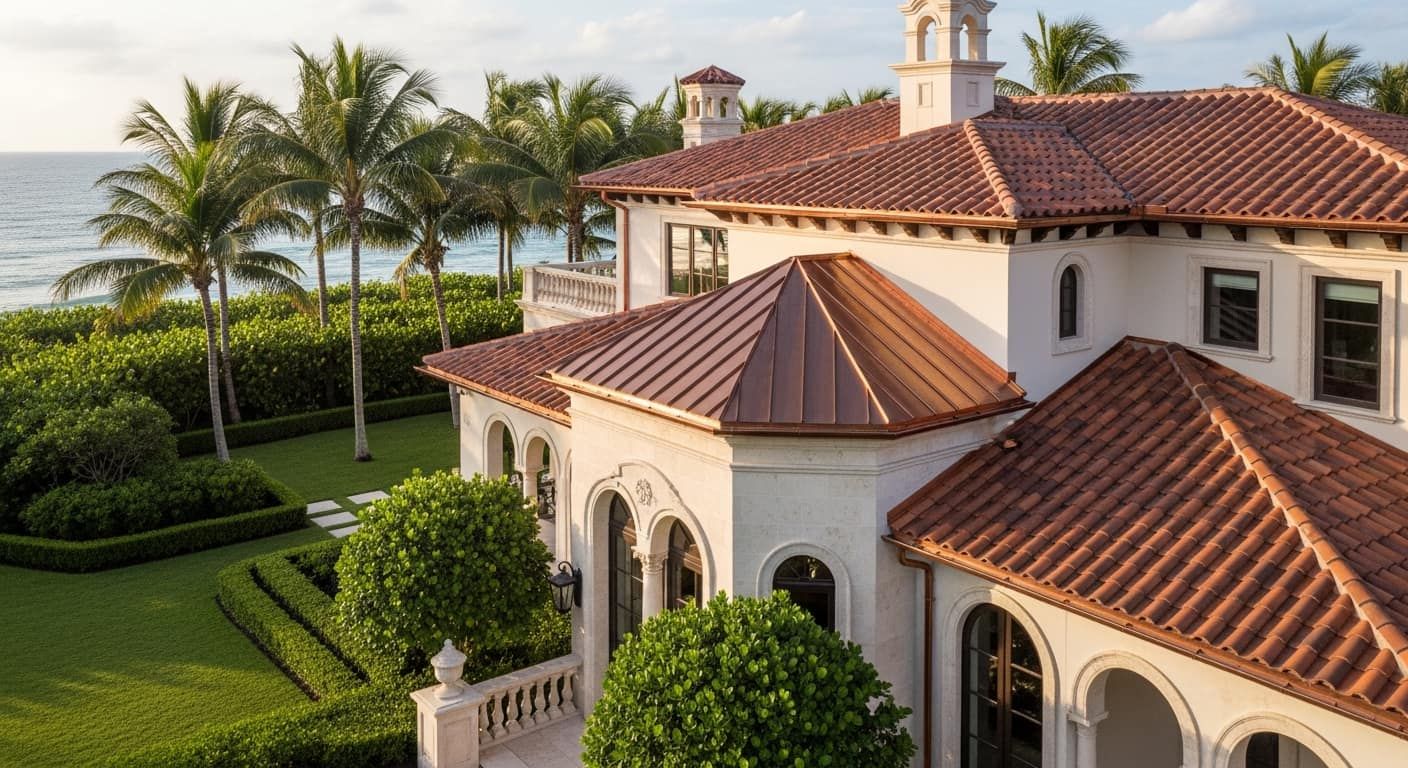
What “island roofing” really means on the Town of Palm Beach
Palm Beach island roofing is its own discipline. The Town of Palm Beach — the barrier island, not the mainland city of West Palm Beach — treats your roof as part of the architecture, not just a building system. Before most roofs can change, the design has to pass an architectural review, and the materials the Town expects are the permanent, authentic ones the island was built with: clay barrel tile, natural slate, and copper. If you own an estate here, this page is the plain-English version of the rules — what gets reviewed, who reviews it, what they’ll approve, and what they won’t.
The legal backbone is the Town’s own code. Architectural review lives in Town Code Ch. 18, Art. III, and it is carried out by the Architectural Commission (ARCOM) for most properties and by the Landmarks Preservation Commission for designated historic estates. A significant change to your roof’s material, profile, or color is a reviewable change. That’s why a roofing quote that works fine in Wellington or Boynton Beach can be a non-starter on the island: it solves for the building permit and ignores the design review that has to come first.
We build to that standard on purpose. Palm Beach RoofCraft scopes island jobs for both tracks — the architectural review and the building permit — specifies in-kind tile, slate, or copper, and prepares the submittal package the board needs to see. We’re a licensed, insured Florida roofing contractor serving the island and the wider Palm Beach County. To be clear about what we can and can’t promise: we don’t speak for the Town and we can’t guarantee a vote. What we can do is make your application the kind boards approve.
On the island, your roof is a reviewed architectural element
The Town of Palm Beach is a separate municipality with its own design-review regime layered on top of the Florida Building Code. That distinction decides whether your roof project is a one-track building permit or a two-track approval — and it’s the thing mainland crews most often get wrong.
What the island expects, by architectural style
The island’s review boards don’t apply one roof to every house — they expect the roof that belongs to the architecture. The Town is dominated by Mizner-era Mediterranean Revival and Spanish Colonial work, with British Colonial, Bermuda, and Monterey homes mixed in. Each style carries an expected roofing material, and on a designated landmark that expectation hardens into an in-kind requirement. Here is the shorthand we work from when we scope an island roof.
| Architectural style | Expected roof material | Where copper comes in |
|---|---|---|
| Mediterranean Revival / Spanish Colonial | Clay barrel (mission) tile — the Mizner signature | Bays, porch roofs, finials, valleys & flashing |
| British Colonial | Natural slate | Dormers, bay roofs, gutters & downspouts |
| Bermuda | White, smooth-rendered tile or membrane | Flashing, scuppers & trim details |
| Monterey / Mission | Clay tile, often two-piece | Balcony & porch roofs, flashing |
| Designated landmark (any style) | In-kind to the original — documented to Landmarks | Restored to match the historic copperwork |
| Asphalt shingle on a historic estate | ✗ Routinely denied by Landmarks / ARCOM | n/a |
ARCOM and Landmarks: who reviews what
Two Town commissions can touch a roof, and which one you face depends on whether your property is a designated historic landmark. Both exist to protect the island’s architectural character; they simply apply that mission at different intensities.
The Architectural Commission (ARCOM) is the broad design review for the Town under Ch. 18, Art. III. It evaluates the exterior of most island properties — including a roof’s material, profile, and color — for compatibility with the neighborhood and the Town’s design criteria. A like-for-like roof in the same material and color is the easiest case; a visible change is what ARCOM scrutinizes.
The Landmarks Preservation Commission governs properties the Town has formally designated as landmarks. Its bar is higher: changes to a landmark are judged against preservation standards, and the default expectation is in-kind replacement that keeps the historic fabric and appearance intact. This is where “you can’t put shingles on it” comes from — not as a slogan, but as a preservation principle the commission applies to tile, slate, and copperwork alike. For the craft side of getting copper right, see our guide to copper roofing.
Not sure whether your island home is ARCOM or Landmarks — or what the board will accept? We’ll tell you straight and put the plan in writing.
Get a Free EstimateHow a Palm Beach island roof approval actually works
An island roof is a two-track approval — an architectural review and a building permit — and the order matters. Here’s the path we run for every island project:
- Confirm the property’s status. First we determine whether the home is a designated landmark (Landmarks review) or a standard property (ARCOM review), and whether the work is a routine in-kind repair or a reviewable change.
- Specify the in-kind material. We match the existing tile profile and color, slate, or copperwork — with manufacturer cut sheets and physical samples — so the board sees exactly what will go on the roof.
- Prepare the submittal. We assemble the architectural- review package: photos, elevations, material samples, and the spec, then place it on the commission’s agenda ahead of the deadline.
- Present and revise. We present the application and respond to the board. A clean in-kind submittal can move quickly; a material or color change may draw a request for revisions and another cycle.
- Pull the building permit and engineer to code. With design approval in hand, we permit the assembly to the Florida Building Code — underlayment, attachment, and flashing carrying a valid Florida Product Approval (FL#) for your wind loads.
- Install, inspect, and document. We install to the approved drawings, pass inspection, and hand you the product-approval and wind-mitigation paperwork your inspector and insurer need.
Why in-kind materials matter — and why asphalt gets denied
It’s tempting to read the island’s rules as red tape, but they protect something real: a clay-tile or slate roof is part of why these estates hold their value and their character. Replacing a barrel-tile roof with asphalt shingle doesn’t just look wrong from the street — it changes the building’s architecture, which is exactly what the Landmarks Commission exists to prevent. That’s why a shingle substitution on a historic estate is routinely denied, and why the smart money goes into doing the real roof once.
The performance side is just as important. The Town of Palm Beach is an oceanfront, barrier-island site in Florida’s Wind-Borne Debris Region, so the roof still has to meet modern code: the assembly — underlayment, fastening or batten system, tile or panel attachment, and flashing — must carry a valid Florida Product Approval (FL#) sized to your address’s design wind loads. The craft of island roofing is satisfying both mandates at once: a historically correct clay-tile, slate, or copper roof that also passes a code inspection and earns its wind-mitigation insurance credit.
Done right, those permanent materials reward the investment. A properly installed copper or slate roof is measured in generations, and copper’s patina is the look the island prizes. The bottom line for a Town of Palm Beach owner is simple: budget for the right material, build the architectural-review window into the schedule, and work with a roofer who handles both tracks. Start with our copper roofing and copper gutters pages, then book a free estimate and we’ll scope your island roof end to end.
The island roofing equation
Palm Beach island roofing FAQs
Do I need ARCOM approval to replace a roof on the Town of Palm Beach?
Can I put asphalt shingles on a historic estate in Palm Beach?
What roofing materials does the island actually expect?
How long does the ARCOM or Landmarks review take?
How is the Town of Palm Beach different from West Palm Beach for roofing?
Do island roofs still have to meet Florida wind and code requirements?
Planning a roof on the island? Start with people who speak ARCOM.
Tell us about the estate and the roof. We’ll scope the in-kind material, prepare the architectural-review submittal, and engineer the assembly to code — one team for both tracks. Free estimate, no pressure.